Safe sleep for babies
Short answer
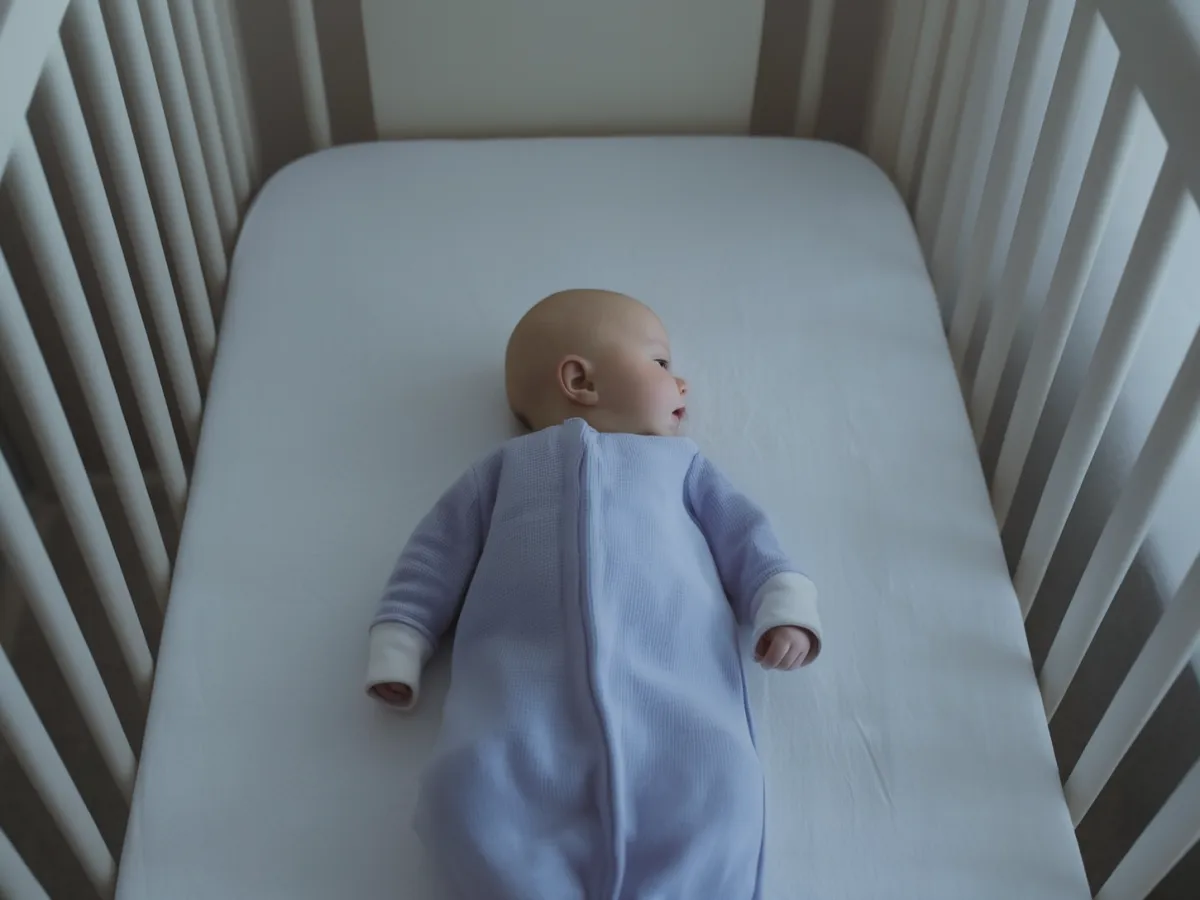
Put your baby down on their back, for every nap and every night, on a firm and flat mattress with only a fitted sheet. Keep the crib bare. Sleep in the same room, but not the same bed, for at least the first six months.
About 3,500 babies die in their sleep each year in the United States, according to the American Academy of Pediatrics (AAP). Some of these deaths are sudden infant death syndrome (SIDS), where no cause is ever found. Many others are accidents: a baby gets wedged against a cushion, tangled in a blanket or trapped under an adult who rolled over.
Most of that risk comes down to a handful of habits you can control. The AAP updated its safe sleep advice in 2022, and this guide walks through it in plain terms.
Back to sleep, every time
Lay your baby on their back for every sleep, naps included, until their first birthday. Babies who sleep on their stomach or side face a much higher risk of SIDS. A baby who is used to the back and is then put down on the tummy once, at daycare or at a grandparent's house, is at especially high risk. So tell everyone who looks after your baby.
A common worry is choking. Healthy babies on their backs do not choke more often. Their reflexes clear spit-up, and the airway sits in a position that protects it.
Once your baby can roll from back to tummy and from tummy to back on their own, you do not need to keep turning them over. Still put them down on their back at the start.
A firm, flat, bare sleep space
The sleep surface matters as much as the position.
- Use a crib, bassinet or play yard that meets the US Consumer Product Safety Commission (CPSC) standards. Since 2011 every crib sold in the US has had to meet them. Drop-side cribs are banned, so skip a hand-me-down with one.
- The mattress should be firm and flat and fit snugly, with no gap wide enough for two fingers between the mattress and the frame. A firm mattress keeps its shape when your baby lies on it, and it does not sink in.
- Use a fitted sheet made for that mattress, and nothing else.
- Keep pillows, quilts, blankets, bumper pads, positioners, wedges and soft toys out of the crib. Crib bumpers and inclined sleepers have been illegal to sell in the US since the Safe Sleep for Babies Act of 2022.
An empty crib can look cold. It is the safest place your baby can sleep, though. If you worry about warmth, use a wearable blanket (a sleep sack) instead of a loose blanket.
Inclined and "nest" products
A sleep surface tilted more than 10 degrees is not safe for sleep. When a young baby's head slumps forward, the chin can press on the chest and close the airway. This is why the CPSC now requires infant sleep products to be flat. Car seats, swings, bouncers and loungers are fine while your baby is awake and watched, but if your baby falls asleep in one, move them to a flat crib or bassinet when you can.
Room-sharing without bed-sharing
The AAP recommends keeping your baby's crib or bassinet in your bedroom, close to your bed, for at least the first six months. Room-sharing makes night feeds easier and lowers the risk of SIDS.
It does not recommend sharing your bed. Adult beds have soft mattresses, pillows, duvets and gaps by the wall, and an adult can roll onto a baby without waking. The risk rises sharply when:
- the baby is younger than four months
- the baby was born early or small
- an adult in the bed smokes, has drunk alcohol, or has taken drugs or medicine that causes drowsiness
- the bed is soft, or there are pillows and loose bedding near the baby
The single most dangerous place to fall asleep with a baby is a sofa or armchair. A baby can slip into the gap between your body and the cushion within seconds. If you think you might drift off during a night feed, feed in your bed rather than on the sofa, with the pillows and covers moved away from the baby, then put the baby back in their own space when you wake.
Things that lower the risk
Some habits lower the risk of SIDS beyond the basics above.
- Breastfeeding helps. Any amount of breast milk counts, and the longer you do it, the more it helps.
- Offer a pacifier when you put your baby down. If it falls out after they fall asleep, you do not need to put it back. If you are breastfeeding, the AAP suggests waiting until feeding is going well, often around three to four weeks.
- Keep smoke away. Avoid smoking during pregnancy, and keep your baby's home and car smoke-free, vapes included.
- Keep up with vaccines. Babies who get their routine shots on time have a lower risk of SIDS.
- Give your baby tummy time while they are awake and watched. It builds neck and shoulder strength and helps prevent a flat spot on the back of the head.
Swaddling and staying cool
Swaddling can calm a newborn, and it is fine if you do it safely. Always place a swaddled baby on their back. Wrap firmly around the chest but loosely at the hips, so the legs can bend up and out. Stop swaddling as soon as your baby shows signs of trying to roll, which often starts around three to four months, because a swaddled baby who rolls onto their tummy cannot push up.
Do not use weighted sleep sacks, weighted swaddles or weighted blankets. The AAP advises against them.
Overheating raises the risk of SIDS. Dress your baby in one more layer than you would wear to be comfortable in the same room. Hats are for outdoors, not for sleeping indoors. A hot, sweaty neck is a sign to take a layer off.
Monitors and gadgets
Baby monitors with cameras or breathing sensors can be handy, and some parents find that they give peace of mind. They do not prevent SIDS, and the AAP says not to rely on them as a safety measure. A bare crib, back sleeping and room-sharing do far more.
A bedtime checklist
Before you leave the crib, run through these:
- Baby on their back.
- Firm, flat mattress, fitted sheet only.
- No pillows, blankets, bumpers or toys.
- Crib or bassinet in your room.
- Baby dressed for the room temperature, with no hat.
- Pacifier offered, if you use one.
Sources
- American Academy of Pediatrics, "Sleep-Related Infant Deaths: Updated 2022 Recommendations for Reducing Infant Deaths in the Sleep Environment," and its parent site, HealthyChildren.org
- Centers for Disease Control and Prevention, Helping babies sleep safely
- US Consumer Product Safety Commission, Safe sleep information
- Safe to Sleep, National Institutes of Health
This page is general information to help you ask good questions. It is not medical or legal advice. Your pediatrician, midwife or a lawyer in your state can tell you what applies to you. Last checked 16 November 2026.